


Elephant Foot Yam, locally known as Suvarna Gedde, is one of the important vegetable crops in India. Its good storage quality, high fibre content and versatility in cooking give it a special place in our food culture. The crop also has opportunities in export markets. It is in demand in several Indian states, particularly Kerala, Karnataka, Andhra Pradesh and Tamil Nadu.
Farmers cultivating this crop have an opportunity to earn a good income. Harvested tubers can be stored for months under suitable conditions, giving farmers some flexibility to sell when market demand and prices are favourable. However, actual profit depends on production costs, yield, storage losses and market prices.
Although the cultivation method is relatively simple, farmers need to understand a few important technical aspects. By planting at the right time, choosing suitable soil and maintaining adequate moisture, it is possible to harvest tubers several times heavier than the planting tubers. Under favourable conditions, a 1:10 ratio — one kilogram of planting tuber producing a tuber weighing up to 10 kilograms — may be achievable. However, this is a possibility, not a guaranteed yield in every field.
The real secret of successful cultivation lies in understanding the plant’s natural growth cycle and providing favourable growing conditions at the right time.
Understand the Dormancy Period of the Tuber;
Elephant Foot Yam is an underground tuber crop that passes through a natural resting period known as dormancy. After the growing season ends, the leaves and above-ground stem dry up. However, the tuber beneath the soil remains alive. After resting for some time, it begins to sprout again when favourable conditions return.
Understanding this natural cycle is important when deciding the planting time for the next crop.
In Karnataka, February–March, corresponding approximately to the local Kumbha month, may be considered a suitable planting period, depending on the local climate, soil moisture and irrigation facilities. Planting during this period allows the plant to begin growing before the monsoon arrives.
Farmers cultivating ginger also commonly plan planting around the season so that the crop can establish itself before the heavy rains. When the crop has established roots before the monsoon, it may be better positioned to withstand wet conditions. The Kumbha period is also traditionally considered a favourable time for sprouting and planting several tuber crops.
However, the ideal planting time should be adjusted according to the crop, local weather and soil conditions.
How Can the Plant Survive When It Is Planted Before the Monsoon?
This is an important question for farmers. If the tubers are planted in February or March, the monsoon may still be several weeks away. How can the newly planted tuber survive until the rains arrive?
The answer lies in moisture conservation and organic mulching.
Before planting, thoroughly wet the prepared pit or raised bed. Place the planting tuber in the prepared soil and cover the surrounding soil with a generous layer of organic mulch, such as dry leaves and suitable grasses. This helps conserve moisture until regular rainfall begins.
After planting, do not leave the soil completely exposed to the sun. The soil around the tuber should not be allowed to dry out.
Organic mulch reduces direct exposure of the soil to sunlight and slows the evaporation of water. As a result, moisture remains in the soil for a longer period.
Warm soil with adequate moisture creates favourable conditions for sprouting and helps the plant establish itself. If the monsoon is delayed, provide irrigation as required.
Select the Right Land for Cultivation:
Land selection is another important factor in Elephant Foot Yam cultivation. The crop grows well in fertile, loose soil with good drainage. A sufficient soil depth is desirable because the underground tuber needs room to expand. Suitable sloping land and elevated areas may also be used, provided soil depth and moisture conditions are adequate.
However, heavy soil in which water remains stagnant for long periods increases the risk of tuber rot.
In Karnataka’s Malenadu region and other high-rainfall areas, special attention must be given to drainage. Before planting in fields where water tends to accumulate, provide suitable drainage channels or prepare raised beds.
Soil rich in organic matter generally has better structure and provides a more favourable environment for tuber development.
Planting Method: Preparing the Pit:
Elephant Foot Yam can be cultivated using the pit method. Depending on field conditions, farmers may also use raised beds, mounds or rows.
A pit measuring approximately 2 feet long, 2 feet wide and 2 feet deep can be prepared where suitable. However, this size is not compulsory for every field. Pit dimensions should be adjusted according to soil depth, planting-tuber size and local agricultural recommendations.
While digging the pit, keep the fertile topsoil separate. Mix it with well-decomposed farmyard manure (FYM) or compost. Place some of this mixture at the bottom of the pit and position a healthy planting tuber on it. Then cover the tuber with the remaining soil and organic manure mixture.
Select a healthy planting tuber with a sound sprouting bud. Handle it carefully to avoid damaging the bud.
Do not place fresh, undecomposed organic waste directly against the planting tuber. Such material may generate heat during decomposition and can potentially damage the tuber.
Why Is Loose Soil Essential for Growing Bigger Tubers?
One aspect farmers should pay particular attention to is the physical condition of the soil surrounding the tuber.
For the underground tuber to grow large, it needs sufficient space to expand. Loose, fertile soil rich in organic matter creates favourable conditions for this expansion.
Stones, hard soil clods and compacted layers can obstruct tuber development. They may also affect the shape of the tuber and make harvesting more difficult.
Therefore, remove large stones while preparing the planting pit and loosen compacted soil. Mix well-decomposed organic manure into the topsoil to create a favourable environment for tuber growth.
Loose soil also supports better drainage and root development. The aim is to provide the growing tuber with enough space, adequate moisture and a healthy soil environment.
Agricultural Waste Is a Resource: The Importance of Organic Mulching:
Dry leaves, grasses and suitable crop residues are valuable resources in tuber cultivation. Instead of treating them as waste, farmers can use them to conserve soil moisture and improve soil conditions.
After planting, spread organic mulch over the soil around the pit. The mulch may form a small mound-like covering, but its purpose is to conserve moisture, not to pile excessive material directly over the sprouting point.
Organic mulching offers several benefits:
- Reduces water loss through evaporation.
- Helps regulate soil temperature.
- Suppresses weed growth.
- Adds organic matter to the soil as the mulch decomposes.
- Reduces the impact of heavy rainfall directly striking the soil surface.
In high-rainfall areas, ensure that mulch does not cause water to accumulate around the planting tuber.
This simple practice helps maintain soil moisture between planting and the arrival of regular monsoon rains.
When Will the Plant Sprout?
Under suitable conditions, sprouts may appear within approximately one month after planting. However, the time taken depends on the quality of the planting tuber, temperature and soil moisture.
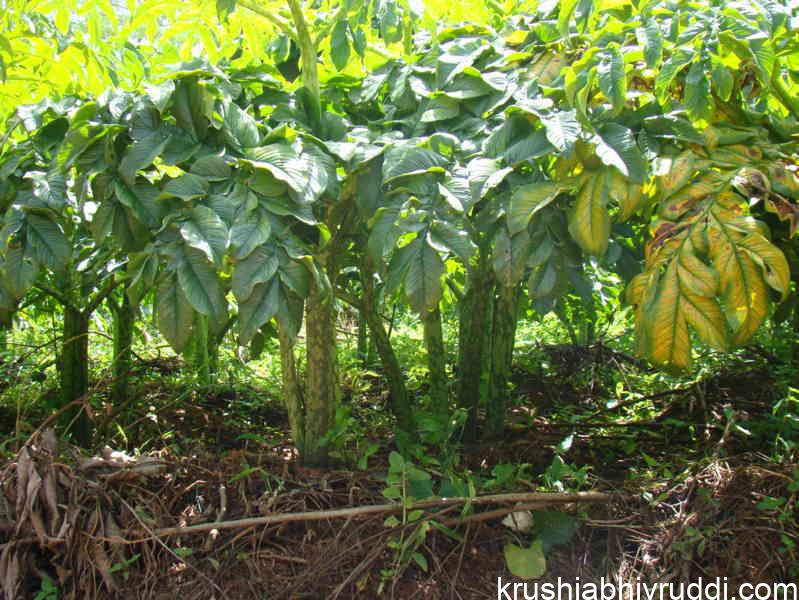
Once the sprout emerges, the plant develops large leaves. These leaves prepare food through photosynthesis, and the food produced supports the development of the underground tuber.
When the monsoon begins, increased soil moisture can favour plant growth.
Nevertheless, farmers should not neglect the crop during this period. Excessive rainfall, waterlogging, weed competition and nutrient deficiencies can all affect plant development.
Application of Organic and Chemical Fertilizers:
Fertile soil and balanced nutrition are essential for good Elephant Foot Yam growth.
Farmyard manure, compost and other suitable organic manures help improve soil fertility and soil structure. Manure and fertilizers may be applied in two or three stages, depending on soil fertility, the amount of organic manure already applied, the crop’s growth stage and local agricultural recommendations.
At planting, well-decomposed organic manure is preferable. During subsequent growth stages, additional nutrients should be supplied according to the crop’s needs.
Potassium plays an important role in tuber development. However, farmers should not assume that applying large quantities of potassium alone will automatically increase yield. Nitrogen and phosphorus are also essential for plant growth.
It is better to determine fertilizer quantities through soil testing and locally recommended nutrient-management practices rather than applying nutrients indiscriminately.
Weeding may be necessary during the rainy season. Once the plant develops a dense canopy, shade around its base may reduce weed growth. If soil around the plant has eroded or settled, replenish it carefully and apply manure as required.
What Is the Right Spacing Between Plants?
Plant spacing depends on the variety, size of the planting tuber, soil fertility and the farmer’s production objective.
Some cultivation practices may use a spacing of approximately 2 feet. However, this is not a universal recommendation for every variety and field. A spacing of approximately 90 × 90 cm is also used in conventional cultivation practices.
Closer planting allows more plants to be grown in a given area. However, competition among plants for moisture, nutrients and sunlight may increase. Wider spacing gives each plant more room for tuber expansion.
Therefore, choose spacing according to local agricultural recommendations and the desired tuber size.
When Is the Right Time to Harvest?
Elephant Foot Yam is a long-duration crop. Many recommended varieties may require approximately 8–9 months to mature, although the actual duration varies according to variety and growing conditions.
During the growing period, the underground tuber gradually increases in size. As maturity approaches, the leaves turn yellow, wilt and begin to dry. This is an important indication that the tuber is approaching harvest maturity.
Farmers should not assume that a tuber has reached its full size merely because four or five months have passed since sprouting. Harvesting time should be decided according to the variety, maturity of the plant and local cultivation experience.
Dig out the tubers carefully to avoid injury. Healthy, undamaged tubers are easier to store and market.
Market Demand and the Possibility of Profit:
Elephant Foot Yam has an established place in Indian food culture, with demand in several parts of the country. When stored properly, the tubers may give farmers some flexibility in choosing when to sell.
However, market prices vary according to location, season, quality, supply and demand. In some markets, prices may reach ₹50 per kilogram or even higher. This should not be treated as a guaranteed price across all regions or as a fixed amount that every farmer will receive.
Before beginning large-scale cultivation, check local market prices, buyers’ requirements, transportation costs and the cost of planting material.
It is advisable to begin with a small area, record the actual production costs and yields, and evaluate the results. Based on this experience, farmers can consider expanding cultivation in the following year.
Conclusion: The Secret Lies in Proper Timing and Soil Management:
Elephant Foot Yam cultivation does not always require complicated technology. Understanding the plant’s natural dormancy, selecting the right planting time, using healthy planting tubers, preparing loose and fertile soil, and managing moisture are the key factors.
Farmers in Karnataka can consider planting before the monsoon, depending on their local climatic conditions. Organic mulching is a useful way to conserve soil moisture during the period before regular rainfall begins. At the same time, preventing waterlogging is equally important in high-rainfall areas.
Ultimately, the secret to successful cultivation lies in planting at the right time, making effective use of organic residues, conserving soil moisture and providing enough space for the tuber to grow.
A Lesson from Kerala’s Farmers
Kerala’s farmers have considerable experience in cultivating Elephant Foot Yam, Colocasia and Tapioca (cassava). Whether farming in Kerala or in other regions, many farmers grow these crops as part of their cultivation practices.
Kerala has a strong presence in the Elephant Foot Yam market. The extent of its market share varies by market and season, so a specific percentage should be verified before publication.
By observing experienced farmers, understanding local growing conditions and adapting suitable cultivation practices, farmers in Karnataka can explore the potential of this crop while managing production and market risks carefully.


