


What Consumers Expect and What natural Pepper Actually Is
When consumers buy black pepper, many naturally look for very dark, bold and attractive peppercorns. A common belief is that the darker the pepper, the better its quality.
But here is the important question:
Is good black pepper supposed to be extremely black? Or have we simply become accustomed to an attractive colour?
This is an important issue because consumer preference can influence the entire market.
Consumers develop their expectations through advertisements, traders, shopkeepers, social media and traditional beliefs. Once a particular appearance becomes associated with quality, consumers start demanding that appearance.
Traders and manufacturers, in turn, try to satisfy that demand.
But what looks attractive is not always an indication of genuine quality.
Why Is It Called Black Pepper?
The name itself can sometimes create confusion.
The pepper fruit is not originally black.
The pepper berries are green when immature and change colour as they mature. After harvesting at the appropriate stage and processing and drying them, the outer surface becomes dark.
That is why we call it black pepper.
The word black refers to the appearance of the processed spice. It does not mean:
“The darker the black colour, the better the pepper.”
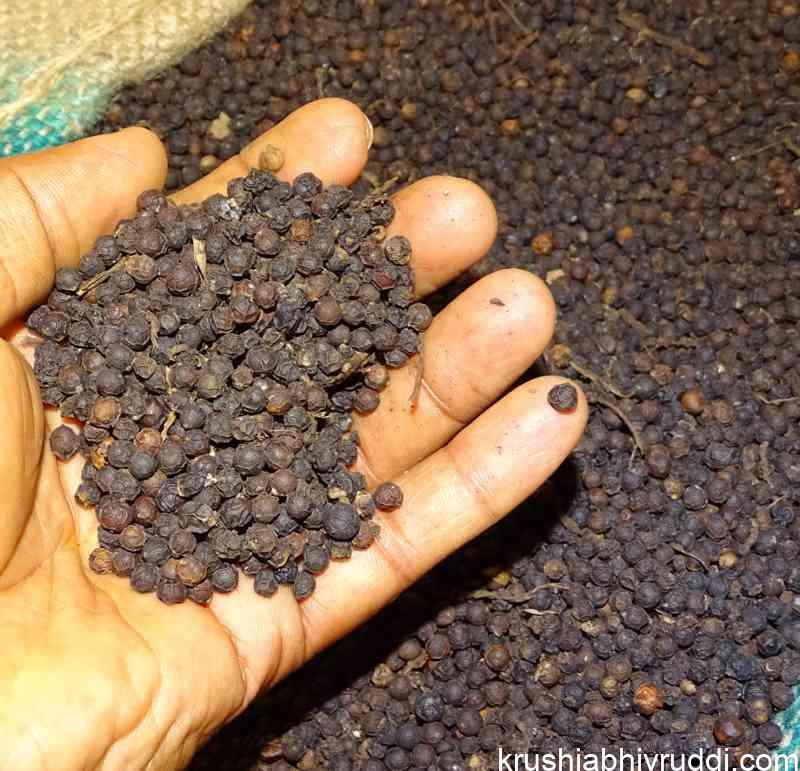
Naturally processed black pepper can have variation in colour. It need not have a perfectly uniform, deep-black, glossy appearance.
Therefore, consumers should not judge pepper quality by colour alone.
When Attractive Colour Becomes the Market Standard:
Suppose consumers always prefer extremely dark black pepper.
A trader who sells naturally processed pepper may find that consumers reject it because it appears lighter.
This creates pressure in the market.
The question then becomes:
Should the product be made naturally, or should its appearance be changed to satisfy consumer expectations?
There have been various allegations and reports of inappropriate colouring or treatment of spices in some markets. However, specific claims about substances such as used engine oil should not be presented as an established practice without laboratory evidence or reliable regulatory findings.
The broader lesson remains valid:
An unusually attractive colour should not automatically be considered a sign of superior quality.
Pepper Powder: An Even Bigger Challenge:
The problem becomes more difficult when we buy pepper powder.
When whole peppercorns are available, consumers can at least see their size, shape and appearance.
But once pepper is converted into powder, it becomes much more difficult for an ordinary consumer to identify what is actually inside.
This is where consumer awareness becomes extremely important.
Genuine black pepper contains piperine, the principal compound responsible for its characteristic pungency.
Good-quality pepper powder should therefore have the characteristic aroma and pungency of pepper.
But consumers’ preferences can create an unusual situation.
Some consumers may not prefer very pungent pepper. They may feel that excessively hot pepper is unpleasant.
If the market demands a mild product, manufacturers may have an economic incentive to reduce the quantity of genuine pepper and use other permitted or cheaper ingredients where legally allowed—or, in the case of adulteration, potentially substitute undeclared materials.
This is why the consumer needs to ask:
“Am I buying pepper powder, or am I buying a powder that only looks and smells like pepper?”
Can We Judge Pepper Powder by Its Spiciness?
Not completely.
This point is very important.
If a small quantity of genuine pepper powder produces noticeable pungency, that can be a characteristic of good pepper—but pungency alone cannot prove authenticity.
Pepper variety, maturity, storage, processing and piperine content can all influence pungency.
Similarly, if a large quantity produces very little pungency, it may raise suspicion, but it does not by itself prove adulteration.
A laboratory test is needed to establish whether a product contains the expected pepper components and whether undeclared substances are present.
Therefore, the consumer should not use a simple home test as a final certificate of genuineness.
Why Would Anyone Adulterate Pepper Powder?
The answer is largely economic.
Pepper is a valuable spice.
If a manufacturer can reduce the amount of genuine pepper in a product and replace part of it with cheaper material, the production cost can decrease.
If consumers cannot easily identify the difference, the practice can become profitable.
This is why powdered agricultural products are generally more difficult for consumers to authenticate than whole products.
The same principle can apply to many commodities:
Whole product → easier to observe.
Powdered product → more difficult to identify.
This is not a statement that every commercially available pepper powder is adulterated. Many manufacturers produce genuine products.
The point is that consumers should understand the increased difficulty of judging authenticity once a product has been powdered.
Consumer Preference Can Accidentally Encourage the Problem
This is perhaps the most important lesson in this article.
- Imagine that consumers say:
- “Pepper should be extremely black.”
- Then the market tries to provide extremely black pepper.
- Imagine consumers say:
- “Pepper powder should not be too pungent.”
- The market may try to provide a milder product.
- Imagine consumers say:
- “Red supari should be very dark red.”
- The market may try to provide very dark-looking supari.
- Imagine consumers say:
- “Black sesame should be absolutely black.”
- The market will respond to that expectation.
Therefore, consumer preference is not a small matter. It can influence how agricultural products are processed and sold.
The Consumer Has to Learn the Natural Product:
Agricultural products are produced by nature.
Their colour, size, shape, aroma and taste naturally vary according to:
- variety,
- maturity,
- growing conditions,
- harvesting time,
- processing method,
- drying,
- storage and
- age of the product.
A natural agricultural product does not always look like a photograph used in an advertisement.
Natural variation is not necessarily poor quality.
Sometimes we have to ask ourselves whether our definition of “quality” has been created by nature—or by the market.
Three Simple Examples
1. Black Pepper
Consumers may prefer extremely dark black pepper.
Reality: Natural black pepper can show variation in colour. Darker colour alone does not establish better quality.
2. Red Arecanut
Consumers may prefer very dark red supari.
Reality: Traditionally processed red arecanut can naturally range from lighter red to reddish-brown or sindoor/meroon shades. Colour intensity alone does not establish quality.
3. Black Sesame
Consumers may prefer very dark black sesame.
Reality: Natural seeds can vary in colour. If colour appears to wash off, it deserves attention, but washing water alone cannot prove that artificial colour has been used. Laboratory testing is necessary.

Dried Grapes: Attractive Yellow or Natural Green?
Dried grapes provide another good example. Green grapes can be dried naturally, and the finished raisins may retain a pale green or dull greenish colour. In commercial processing, treatments such as sulphur dioxide and food-grade processing aids may be used to help retain or develop a lighter, more attractive colour. Consumers, however, often prefer the bright, transparent yellow appearance and may consider it a sign of better quality.
Here again, the question is: Are we buying quality, or are we simply buying the colour that we have been taught to prefer? The important point is not that every attractive yellow raisin is adulterated, but that consumers should understand the difference between natural appearance and permitted processing treatment, and rely on proper labelling and food-safety standards rather than colour alone.
What Should Consumers Do?
Consumers do not need to become laboratory scientists. They simply need to change their thinking.
- Do not ask only: “Does it look attractive?” Also ask:
- Is this the natural appearance of the product?
- Is the product properly labelled?
- Who manufactured it?
- Does it have the required food-safety information?
- Is the seller trustworthy?
- Is there an unusually strong colour, smell or other characteristic that deserves investigation?
For products where adulteration is suspected, laboratory testing is the dependable way to establish what is actually present.
The Final Message
The farmer grows the product.
The trader buys it.
The manufacturer processes it.
The consumer finally eats it.
Therefore, quality is a shared responsibility throughout the chain.
But the consumer has one very powerful influence—the consumer’s demand.
If consumers demand only very black pepper, very red supari, very dark sesame and other artificially attractive appearances, the market will try to satisfy that demand.
Instead, let us create a different demand:
“Give me genuine food, not merely attractive food.”
“Give me natural quality, not artificial appearance.”
“Tell me what is actually inside the product.”
When consumer awareness improves, market practices can also change.
The most attractive agricultural product is not necessarily the best product.
The most important quality is what we cannot see with our eyes—what is actually inside it.