


This year’s rainfall pattern has given us a serious warning. Are we prepared for the water shortage that may come in the coming months?
For farmers in Coastal Karnataka and Malnad, rainfall is not just a weather event—it is the foundation of agriculture. Traditionally, we receive substantial rainfall from June to October. But this year, the situation has been very different.
The monsoon arrived late, and the rainfall season appears to have ended much earlier than we normally expect. More importantly, even areas that traditionally receive heavy rainfall, including parts of Coastal Karnataka and Malnad, have experienced a significant rainfall deficit.
This should not be viewed simply as one bad agricultural season. It should be treated as a warning about the water situation ahead.
The rain has stopped, but the crop still needs water:
Normally, farmers in these regions can depend largely on monsoon rainfall for several months. But now the situation has changed.
Water flow in many rivers has reduced considerably. Small streams and natural water channels that normally carry water through the landscape are already drying up.
The situation is even more serious in the upper and hilly areas, where many farms depend on rainwater and natural springs.
For crops such as arecanut, pepper, coconut and other plantation crops, this is the time when farmers need to start thinking about protective irrigation immediately, particularly in locations where the soil moisture has already fallen sharply.
The sharp sunlight is another warning:
After the prolonged cloudy and rainy conditions of the monsoon, the sudden appearance of strong sunshine can create considerable stress on plants.
The problem is not simply that the temperature is high.
When soil moisture becomes inadequate and strong sunlight continues for several days, plants lose water through transpiration faster than the roots can replace it. The first signs may appear as leaf drooping, loss of leaf freshness, reduced growth and, in severe cases, leaf scorching and crop stress.
Therefore, farmers should not wait until visible damage becomes severe before beginning protective irrigation.
But where will the irrigation water come from?
This is the most important question.
For many farmers, the answer is borewell water.
And this is where we have to think very carefully.
Karnataka’s agriculture already depends substantially on groundwater. Government and agricultural reports identify groundwater depletion as one of the major constraints affecting rain-fed agriculture. Karnataka also has a very large rain-fed farming area.
A borewell is not a permanent source of water.
It is only an opening into an underground water system that has to be recharged by rainfall.
If the rainfall entering the soil decreases, groundwater recharge also decreases.
Therefore, when rainfall is low, pumping more water from borewells cannot be the long-term solution.
The arecanut question cannot be ignored:
There is another issue that we need to discuss honestly.
Arecanut cultivation has been expanding in many parts of Karnataka because of its attractive market price. When prices are good, farmers naturally want to increase the area under the crop.
But arecanut is a perennial plantation crop. Once it is planted, the farmer has to provide water and other inputs for many years.
This creates a dangerous situation when expansion of cultivation happens faster than the availability of dependable water.
Good arecanut prices can encourage more planting—but a good market price cannot create groundwater.
If rainfall is insufficient and groundwater recharge is poor, increasing the area under irrigated arecanut can increase pressure on the same limited underground water resources.
This is why the present situation demands a serious discussion about whether further expansion of water-intensive plantation areas should continue without first assessing the availability of water.
More borewells are not the answer:
When a borewell becomes weak, the common response is often:
“Let us drill another borewell.”
If the second borewell fails, another one is attempted.
This may provide a temporary solution for an individual farmer. But if thousands of farmers follow the same approach, the problem becomes much larger.
We are then competing for the same underground water.
In a year of poor rainfall, repeated borewell drilling can become an expensive gamble.
The farmer loses money, groundwater levels continue to fall, and eventually even deeper borewells may fail.
Therefore, groundwater should be treated as a community resource, not as an unlimited private resource.
Water-saving irrigation should become compulsory:
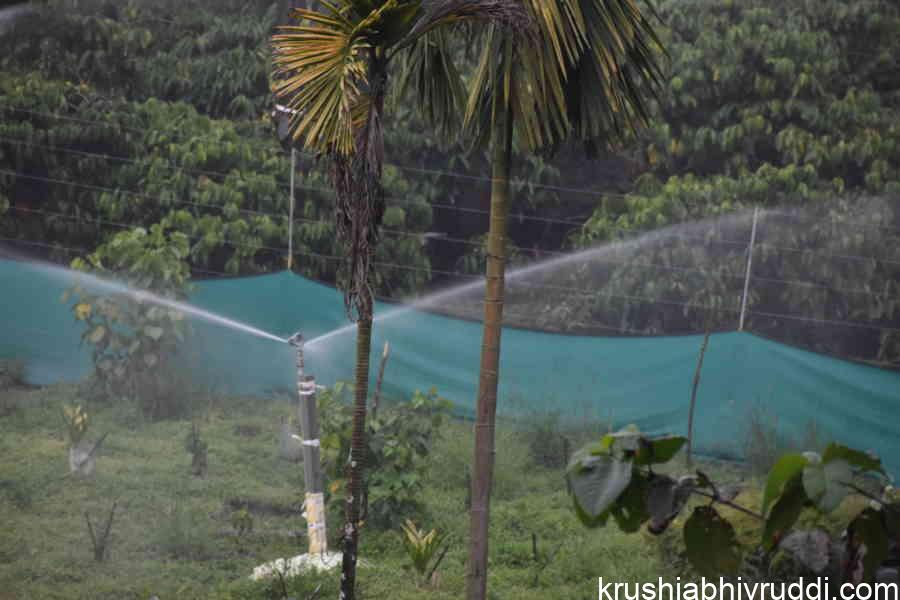
This is where government policy has an important role to play.
In water-scarce situations, irrigation should not mean simply supplying more water to the crop.
It should mean supplying the right quantity of water at the right place and at the right time.
Drip irrigation is one important method for achieving this.
Instead of applying large quantities of water over the entire field, drip irrigation delivers water close to the root zone in controlled quantities.
ICAR research and advisories have recognised drip irrigation as an important technology for plantation crops, including arecanut. Research from ICAR-CPCRI has also demonstrated the benefits of fertigation through drip systems in arecanut.
But installing drip irrigation alone is not enough.
The irrigation system must also be properly operated.
In some areas, farmers still use high-discharge irrigation methods. Even when sprinklers are convenient, applying more water than the crop actually needs is not scientific water management.
The objective should be:
“Maximum crop production with minimum water use.”
Not:
“More water means more production.”
Government must think beyond subsidies:
Government schemes should not focus only on providing subsidies for irrigation equipment.
A stronger water-management policy is needed.
For water-stressed regions, the government could consider regulations requiring water-efficient irrigation systems for new plantation development and for expansion of existing plantations, particularly where groundwater is the primary source.
Before approving large-scale expansion of perennial crops, the availability of water should also be considered.
A scientific system could classify areas according to groundwater availability:
- Safe areas – limited expansion may be permitted.
- Semi-critical areas – only water-efficient irrigation should be permitted.
- Critical areas – new water-intensive plantations should be restricted.
- Over-exploited areas – further expansion should be discouraged or temporarily stopped.
Such a system would be much better than waiting until borewells completely fail.
Should new arecanut planting be postponed?
This question deserves serious public discussion.
If the current water shortage continues and groundwater recharge remains poor, should new arecanut planting be temporarily postponed in water-stressed areas?
In my opinion, this possibility should at least be examined scientifically.
A temporary restriction on new plantations need not mean a permanent ban on arecanut cultivation.
Instead, it could mean:
“First assess the water availability; then expand the crop.”
Farmers who already have established plantations should receive priority for protecting existing crops rather than encouraging unlimited expansion.
After the next adequate monsoon and groundwater assessment, the situation can be reviewed again.
This would protect both farmers and groundwater resources.
We must harvest rain before we pump groundwater:
Another important solution is rainwater harvesting.
When heavy rain does arrive, allowing the water to quickly run away through streams and rivers is a missed opportunity.
Farm ponds, recharge pits, contour trenches, percolation structures, check dams and other suitable watershed measures can help retain water and improve groundwater recharge.
Karnataka’s official land-resource systems already incorporate tools for assessing crop water requirements, soil-moisture balance and water budgeting. These scientific approaches need to reach farmers at the field level.
The question should not be:
“How much water can I pump?”
It should be:
“How much water has my farm received, how much can the soil store, and how much can I safely use?”
Farmers also need to change their approach:
Government regulations alone cannot solve this problem.
Farmers also have to understand that water is becoming one of the most valuable inputs in agriculture.
We should:
- Use drip irrigation wherever suitable.
- Avoid unnecessary high-volume irrigation.
- Irrigate according to soil moisture and crop requirement.
- Mulch the soil to reduce evaporation.
- Maintain organic matter in the soil.
- Harvest rainwater wherever possible.
- Recharge borewells and groundwater systems where technically suitable.
- Protect natural streams and drainage channels.
- Avoid unnecessary expansion of water-dependent crops.
- Give priority to saving established plantations during severe water shortage.
This year’s shortage may be a lesson for the future:
One year of poor rainfall does not necessarily mean that every coming year will be dry.
But climate variability is making rainfall increasingly difficult to predict. Karnataka’s official climate assessments identify high spatial and temporal variability in rainfall and recurring drought as significant risks.
Therefore, we should not wait for another drought before taking action.
Rainwater is our first irrigation source. Groundwater is our backup—not our first choice.
If we use groundwater recklessly during a poor-rainfall year, we may save today’s crop but create a much bigger problem for tomorrow’s crop.
The real question is not whether there will be rain:
The real question is:
Can our present agricultural system survive if rainfall becomes uncertain?
The answer will depend on how intelligently we manage water today.
This year’s early end to rainfall should therefore be treated as a warning—not a reason for panic.
Let us protect the water we have.
Let us reduce unnecessary irrigation.
Let us recharge the groundwater.
Let us adopt scientific irrigation.
And before expanding water-dependent plantation crops, let us first ask one simple question:
“Do we have enough water to support this crop for the next 20 years?”
That question may be more important than today’s crop price.
