


A 30-acre arecanut and mixed crop farming near Thirthahalli Shivamogga dist.shows how organic matters can become the foundation of sustainable production.
What does organic farming really mean?
Is it simply stopping chemical fertilizers?
Is it buying an organic manure from the market and applying it to the crop?
Or is it about creating a living soil that can continuously supply nutrients to the plants?
A recent visit to a farmer’s plantation near Thirthahalli gave me an opportunity to think about these questions again.
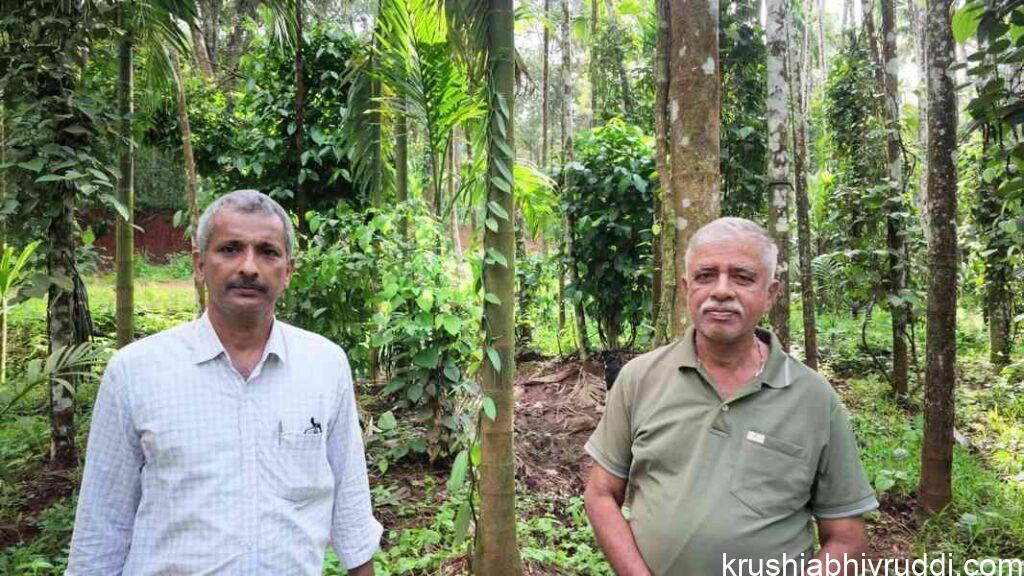
At Trayambakapura, I visited the arecanut and other plantation of Mr. Dinesh, SARU a farmer cultivating around 30 acres of arecanut.
His speciality is organic farming.
I have visited several farms where farmers describe their cultivation as organic. I am not always completely satisfied with all such systems because sometimes the word organic is used more as a label than as a scientifically managed farming system.
But Mr. Dinesh’s farm was different.
What impressed me was not merely that he avoids chemical fertilizers. It was how systematically he collects, processes and returns organic materials to his soil.
His approach is simple in principle, but substantial in scale:
Do not waste the organic resources available around the farm. Convert them into soil fertility.
And this is where his farming becomes interesting.
Our ancestors were practising resource recycling:
Before chemical fertilizers became available, farmers had to depend almost entirely on resources available locally.
Leaves, crop residues, cattle manure, Green leaves and its branches, wood, ash and other organic materials were returned to agricultural land.
The important point is not that everything our ancestors did was necessarily scientifically perfect.
The important lesson is that nutrients removed from the soil were being recycled through locally available resources.
Mr. Dinesh has adopted this basic principle, but on a much larger scale and with considerable planning.
Instead of allowing organic material to go to waste, he brings it back into the nutrient cycle of his plantation.
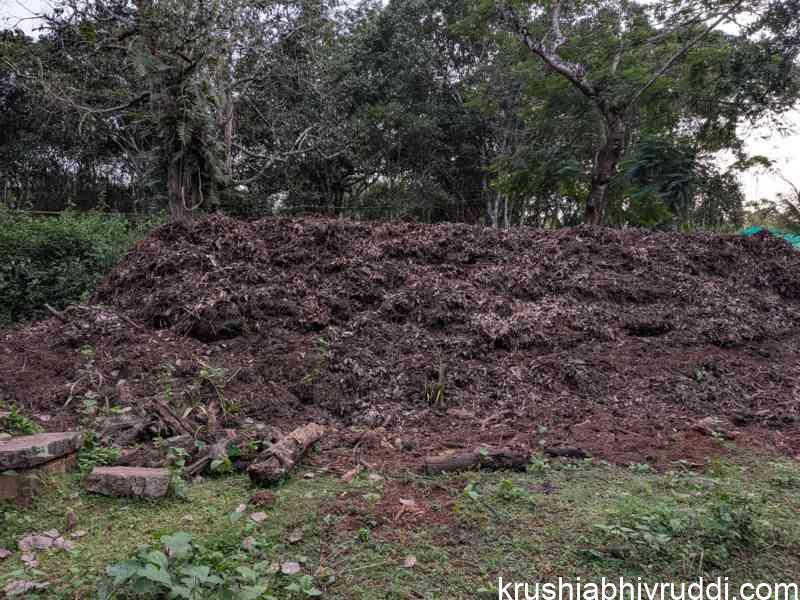
His compost pit is the heart of the system:
Near his plantation, there is a land locally known as Soppinabetta.
In the local traditional system, such land may be used by adjoining landholders for collecting leaves, fallen branches and for grazing cattle, although right of enjoyment remains with the respective landowner.
Mr. Dinesh makes use of the organic resources available there. He was not planted any crops in this land and used as input for manure.
Every year, he collects large quantities of fallen leaves.
During the rainy season, branches of trees may break because of the weight and weather conditions. Instead of leaving these materials to decay unused or allowing them to be burned, he collects them and brings them to his composting system.
The quantity is enormous.
His compost pit receives many tractor loads of organic material.
The composting area is located below his house, which also helps him utilize the slurry coming from his cattle-based biogas system.
Twenty-five cattle are part of the nutrient cycle:
Mr. Dinesh maintains around 25 local cattle, primarily as part of his manure and biogas system.
Cow dung is used for producing biogas.
But the process does not end there.
The slurry coming out of the biogas unit is directed towards the composting area and spread over the accumulated organic material.
This is an important principle of farm sustainability. The investment less quick manure making factory is cow shed. With In 12 hours cattles give oraganic maure.
Nothing is treated as waste. One process becomes the input for another.
- Leaves become compost material.
- Branches become organic matter.
- Cow dung produces biogas.
- Biogas slurry returns nutrients and moisture to the compost.
Finally, the finished organic material goes back to the plantation. Plantation gives grass food for cattle.
It is essentially a farm-level nutrient recycling system.
He does not allow the compost to remain untouched:
Because the quantity of material is very large, natural decomposition alone would take considerable time. His composting technique follows an aerobic method, where adequate air circulation supports the activity of beneficial microorganisms. As a result, the organic materials decompose faster and are converted into nutrient-rich compost more efficiently.
Mr. Dinesh therefore turns the compost approximately twice, using a JCB.
The quantity involved can reach several dozen tractor loads.
After the monsoon begins, he also purchases approximately two to three lorry loads of sheep manure and adds it to the composting system. Along with JCB earth worms, to eate earth worms rates , to eat rats pigs come there and they also do turning work.
The total quantity of material accumulated in the compost system is estimated at 40–50 loads or several hundred tonnes, depending on the season and material available.
This is not a small backyard composting operation.
It is a large-scale nutrient recycling system designed for a large plantation.
Three rounds of manure application:
The finished organic manure is not dumped everywhere randomly.
It is applied systematically to the arecanut plantation.
The application is rotated.
One year, manure is applied along one row between the arecanut rows.
The following year, another direction is covered. It is in the place of active root zone area.
The next year, the remaining area around the palms (near the base) receives the material.
In this way, the entire plantation, entire root zone receives substantial quantities of organic matter over a cycle.
The quantity applied is also significant—according to the farmer, around 50 kg or more for approximately 10 square feet of area, depending on the location and requirement.
This is an important difference between merely using organic manure and building soil organic matter through continuous application.
His ‘Sudumannu’ experiment:
Another interesting practice on the farm is the preparation of what is locally called Sudumannu.
For the last four to five years, Mr. Dinesh has been preparing this material using approximately equal proportions of organic biomass and soil.
The process involves placing a layer of organic material—such as wood pieces, shrubs and other biomass—followed by a layer of soil.
The layers are repeated several times.
The material is then subjected to controlled heating.
Because of the soil layers, the organic material does not burn completely. Instead, it undergoes partial burning or charring under limited oxygen conditions.
The resulting material resembles a mixture of partially charred biomass and heated soil, somewhat comparable in principle to a locally prepared biochar-type material.
He applies approximately 25–30 kg around each plant every year.
An interesting observation about leaf spot:
Leaf spot is an important concern in arecanut plantations, particularly under conditions of heavy rainfall and nutrient leaching.
Potassium deficiency or inadequate potassium availability has been suggested as one of the factors that can contribute to poor leaf health in some situations.
Mr. Dinesh had his Sudumannu material analysed in a laboratory and reports that it contained approximately 1.5% potassium.
After incorporating this practice into his nutrient-management system, he observed a considerable reduction in leaf-spot symptoms in his plantation.
This is an interesting farm-level observation, although it should not be interpreted as proof that Sudumannu alone controls leaf spot.
Disease development in arecanut is influenced by several factors, including nutrition, rainfall, humidity, drainage, canopy conditions and pathogens.
Nevertheless, the observation demonstrates something important:
Farmers can experiment, test their materials and observe results rather than simply following a practice because it is called “organic.”
Acacia leaves become another source of mulch:
Another practice that caught my attention was his use of fallen Acacia leaves.
In the Malenadu region, large areas of government plantations contain Acacia trees. During the dry period, considerable quantities of fallen leaves accumulate.
Mr. Dinesh collects these fallen leaves and uses them as mulch in his arecanut plantation.
Acacia leaves may not decompose as quickly as some softer green leaves.
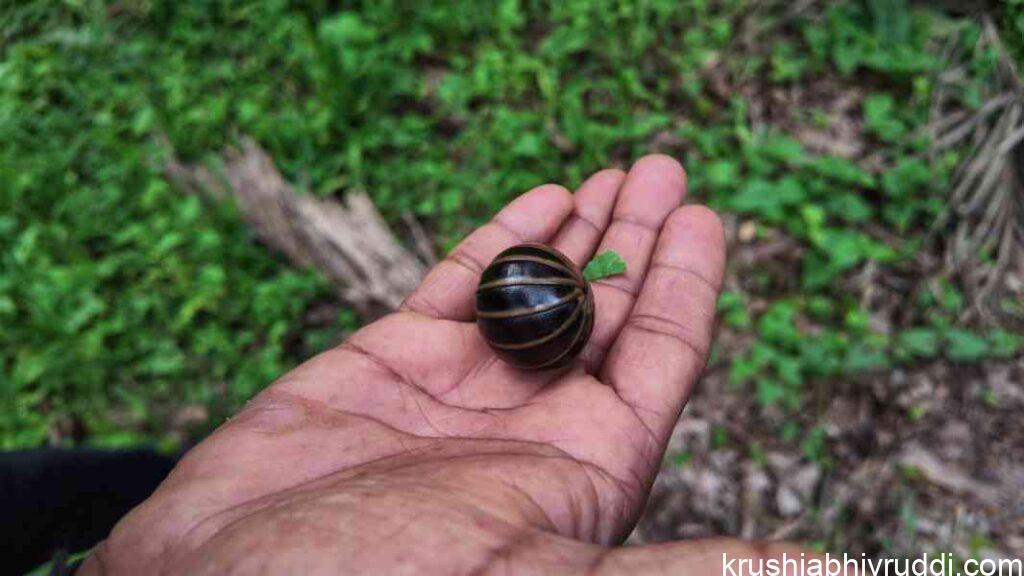
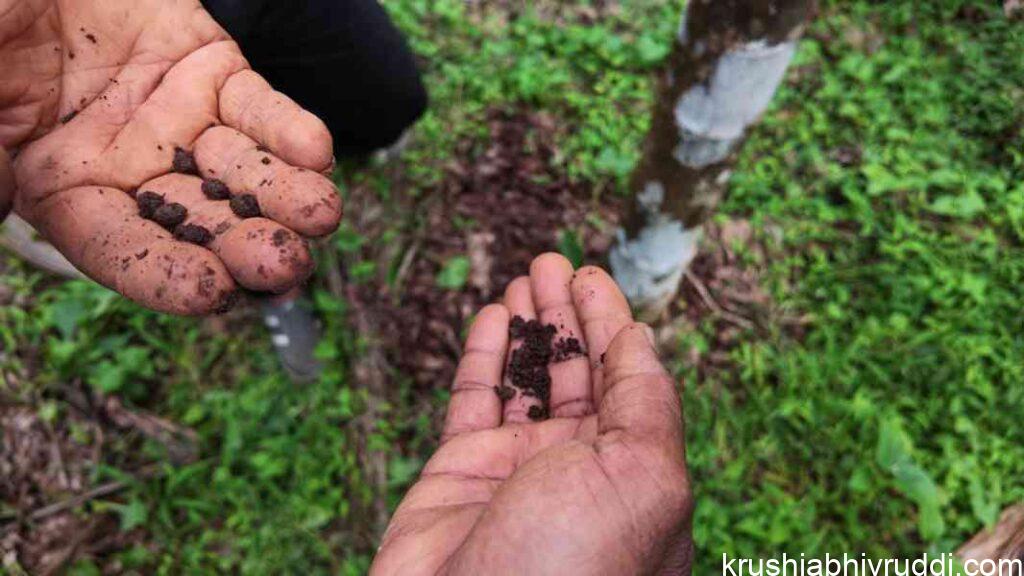
But decomposition does not depend on earthworms alone. Here, we can find a large number of Gangehulu, which actively feed on the organic matter and contribute to its decomposition. The material they consume passes through their digestive system and is returned to the soil as partially decomposed, nutrient-rich excreta. In this way, they perform a role similar to earthworms by helping to break down organic residues, improve soil structure and support natural nutrient cycling.
Different organisms participate in the decomposition of different materials.
Various insects, fungi, bacteria and other decomposers contribute to breaking down organic residues.
Thus, even apparently slow-decomposing leaves have a role in the soil ecosystem.
Walk on his plantation and feel the difference:
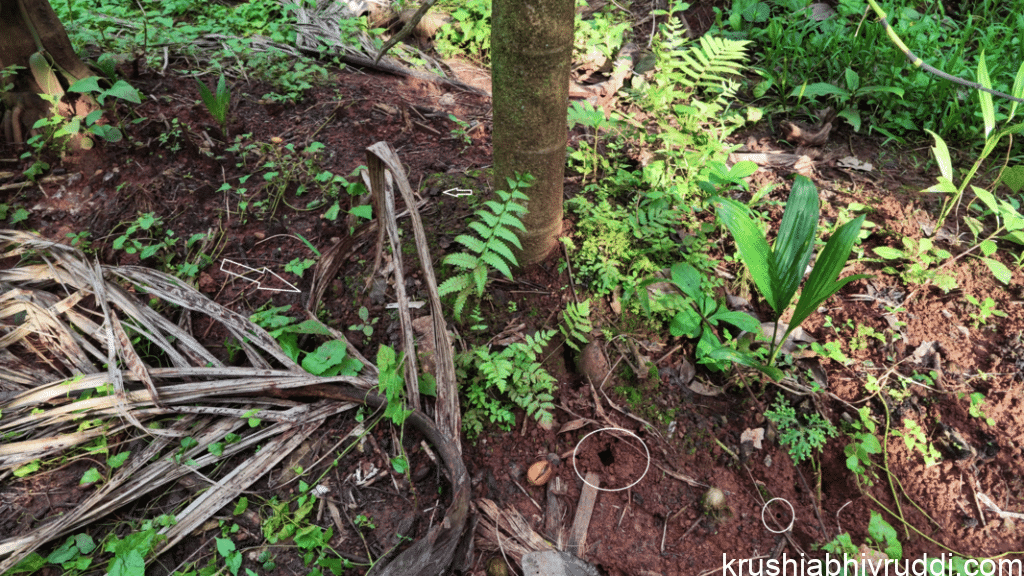
One of the most noticeable features of Mr. Dinesh’s plantation is the soil surface.
When you walk through the garden, the soil gives a soft, sponge-like feeling under your feet.
This is what happens when large quantities of organic matter are continuously returned to the soil.
Organic matter can contribute to better soil aggregation, improve water-holding capacity and create better conditions for soil organisms.
The plantation floor is not a dead surface. It is a living ecosystem.Fallen leaves attract decomposers.Decomposers become food for other organisms.Those organisms become part of a larger food web.
This natural activity continuously disturbs and loosens the upper soil layers. In other words, nature itself performs a form of biological soil tillage.
A forest-like soil inside an arecanut plantation:
Perhaps the most interesting observation is the similarity between the soil surface of this plantation and the soil floor of a natural forest.
In a forest, nobody brings a tractor every year to remove every fallen leaf.
- Leaves fall.
- Branches fall.
- They decompose.
- Microorganisms and soil organisms break them down.
- Nutrients are gradually released.
- Roots absorb them.
- Again, leaves fall.
- The cycle continues.
Mr. Dinesh is attempting to recreate a similar nutrient cycle within his plantation.
The difference is that his plantation is a managed agricultural ecosystem, where nutrients removed through crop production must ultimately be replenished.
Organic matter is much more than a source of nutrients:
This is perhaps the biggest lesson from his farm.
Organic manure should not be viewed merely as a substitute for urea, DAP or potash.
Its value is much broader.
Organic matter can act as:
- a source of several plant nutrients,
- a source of carbon,
- a soil conditioner,
- a contributor to better soil structure,
- a habitat and food source for soil organisms,
- a contributor to water-holding capacity,
- and an important part of nutrient cycling.
Therefore, comparing organic manure and chemical fertilizer simply on the basis of “how many kilograms of nitrogen, phosphorus or potassium they contain” misses an important part of the story.
A chemical fertilizer is generally designed to supply specific nutrients in concentrated and readily available forms.
Organic matter performs multiple functions simultaneously.
That is its real value.
But organic farming also requires nutrient balance:
There is one important scientific point that farmers should remember.
It is true that soil contains most of the elements required by plants.
But the mere presence of a nutrient in soil does not necessarily mean that the plant can access enough of it.
Plants require nutrients in particular chemical forms and concentrations.
A crop also continuously removes nutrients from the field.
Therefore, organic farming should not mean simply applying large quantities of organic material and assuming that every nutrient requirement will automatically be fulfilled.
The farmer should understand:
- What is being removed?
- What is being returned?
- What nutrients are present in the manure?
- How quickly are they released?
- What does the soil test show?
This is where scientific organic farming becomes different from organic farming merely by name.
The result is visible beyond arecanut:
The benefits of this soil-management approach are not limited to arecanut.
Mr. Dinesh also grows black pepper and other mixed crops.
The pepper vines in the plantation appeared healthy, and the overall garden showed the effect of continuous organic-matter management.
When soil structure, moisture conditions, biological activity and nutrient availability are maintained, the entire plantation ecosystem can benefit.
Organic farming should not be a label:
I have seen farmers proudly saying:
“My farm is organic.”
But when we look closely, sometimes the yield is poor, the soil is neglected and the nutrient-management system is incomplete.
In some cases, commercially available products are purchased and applied simply because they carry the word organic on the package.
That alone does not create organic farming.
There are also situations where farmers claim to be organic but quietly use chemical fertilizers or other inputs when nobody is watching.
That is not the purpose of organic farming.
The real question is not:
“Are you using an organic product?”
The real question is:
“What are you doing to maintain the health and fertility of your soil?”
Dinesh’s farm gives us a different perspective:
Mr. Dinesh’s plantation demonstrates a different approach.
He is not depending on one single organic input. He is combining:
leaf litter + tree branches + cattle manure + biogas slurry + sheep manure + farm residues + mulch + biological activity + continuous recycling.
Together, these materials create a system.
The objective is not merely to feed the arecanut palm.
The objective is to feed and maintain the soil.
When the soil is healthy, the plant gets a more favourable environment for root growth, nutrient cycling and biological activity.
That is the real foundation of sustainable agriculture.
A model worth observing—not blindly copying:
I would not suggest that every farmer should simply copy Mr. Dinesh’s exact quantities and methods.
Every farm is different.
Soil type, rainfall, drainage, crop density, available biomass, livestock, nutrient removal and disease pressure vary from one plantation to another.
But farmers can certainly learn from his principle:
Use what the farm and surrounding ecosystem can sustainably provide. Recycle it. Return it to the soil. Observe the result. Test where necessary. Correct the deficiencies.
That is a much more meaningful approach than simply calling a farm “organic.”
Hats off to a farmer who is building his soil:
What impressed me most during my visit was not the 30 acres of arecanut.
It was the way Mr. Dinesh looks at waste as a resource.
- A fallen leaf is not waste.
- A fallen branch is not waste.
- Cow dung is not waste.
- Biogas slurry is not waste.
- Sheep manure is not waste.
- Even slow-decomposing leaves have a role.
- Everything is brought back into the soil nutrient cycle.
His farm shows that organic farming can be more than an ideology.
It can be a practical system of soil management, nutrient recycling and biological farming.
His approach has also attracted the attention and appreciation of agricultural professionals and scientists associated with the local agricultural and horticultural University of Shivamogga.
For me, the most important message from Trayambakapura, Saru is simple:
“Do not think only about feeding the plant. Build the soil that feeds the plant.”
If we can restore organic matter, maintain soil structure, encourage biological activity and recycle the resources available around the farm, we are not merely growing today’s crop.
We are building the foundation for tomorrow’s agriculture.
Hats off to Mr. Dinesh for demonstrating this principle on the ground.

