


Herbicides are one of the weed control methods used by farmers when weed growth becomes excessive. Weeds are competitors of the main crop, competing for water, nutrients, sunlight and space, and they can also interfere with various farm operations. At certain stages of crop growth and in some seasons, controlling or removing weeds becomes essential. However, many farmers are confused about whether herbicide application is safe or harmful to the crop, soil, environment and human health. Therefore, farmers need to choose between herbicides and other weed-control methods carefully, considering the type of crop, season, stage of crop growth and the nature of the weed problem.
Our ancestors understood this through practical experience.
In earlier times, weed control was mainly done manually. Farmers and farm workers removed weeds by hand or with simple agricultural tools. In many villages, the removed weeds were not simply thrown away. They were often taken home and fed to cows and buffaloes, where suitable, or used as organic material.
This created a simple cycle:
Soil → Weed → Animal → Manure → Soil
Because weeds were regularly removed, they had less opportunity to compete strongly with the main crop.
Manual weed removal also had another advantage. The farmer could physically observe the field while removing weeds and notice pests, diseases, waterlogging, soil problems and other changes in the crop.
However, manual weed removal required considerable labour. As labour became expensive and difficult to obtain, farmers began looking for faster methods.
Weeds Are Not Always Bad:
There is an important distinction here.
During heavy rainfall, completely removing vegetation from every part of a field may expose the soil to direct raindrop impact and runoff. Ground vegetation can help protect the soil surface from erosion.
Therefore, weed control should not necessarily mean keeping every square metre of farmland completely bare throughout the year.
In horticultural plantations, a controlled ground cover can sometimes be useful.
But there are particular periods when weed control becomes especially important.
During manuring
Heavy weed growth can consume part of the nutrients and moisture intended for the crop.
During harvesting
Excessive weeds can make harvesting difficult, particularly in plantations and orchards.
During critical crop-growth stages
Young crops can suffer significant competition from weeds for water, nutrients, light and space.
Therefore, the real objective should be proper weed management—not blind elimination of every plant growing between the crops.
Weeds Can Also Provide Shelter for Pests:
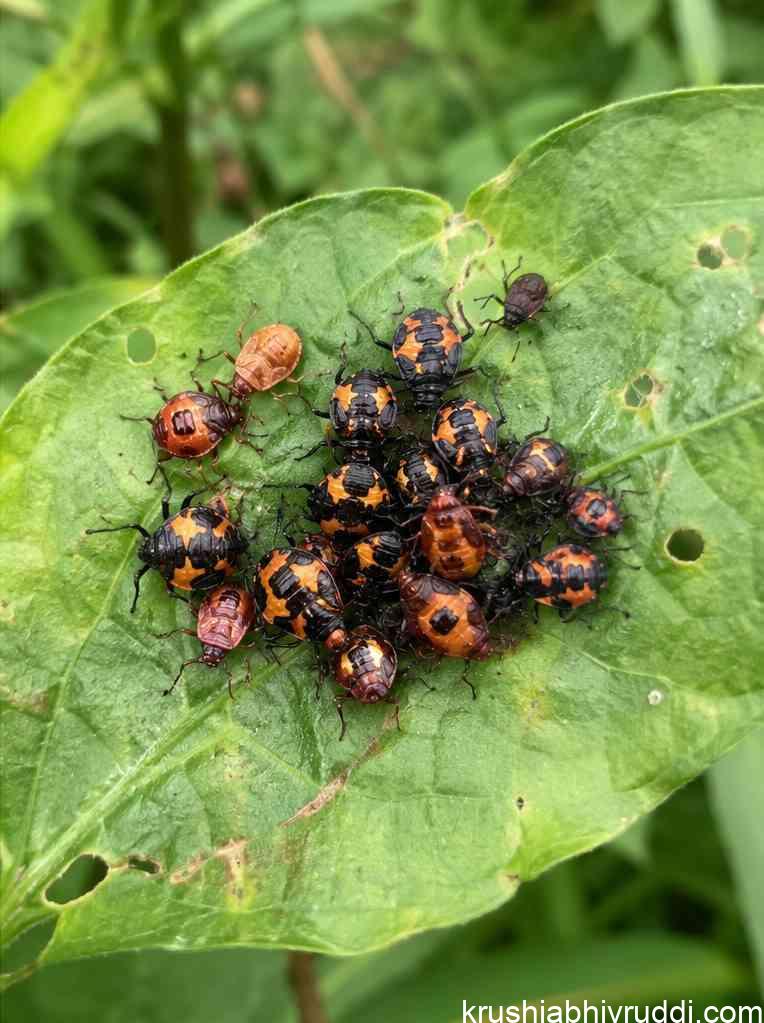
There is another reason why weed management deserves attention.
Some weeds can act as alternative hosts for insects, mites, pathogens and other pests. Certain insects may survive and reproduce on weeds when the main crop is not available or when conditions are unfavourable.
Later, when the weed dries or the pest population increases, the insects may move onto the cultivated crop.
Therefore, in some situations, weed control can also contribute to pest management.
But this does not mean every weed is a pest host. The relationship depends on the particular weed, crop, insect and local ecosystem.
When Did Chemical Weed Control Begin?
Farmers used non-chemical weed-control methods long before modern herbicides. Experiments with inorganic chemicals for weed control were already being conducted in Europe and North America in the late 19th century.
However, the major revolution in modern chemical weed control came in the 1940s.
The discovery and development of 2,4-D during the early 1940s was a major milestone. It became commercially available as a selective herbicide in the mid-1940s and could control many broadleaf weeds without seriously damaging important grass crops such as wheat and maize.
This opened a completely new era in agriculture.
From the 1950s onward, many other herbicides were developed, including chemicals with different modes of action and different patterns of selectivity.
Today, herbicides include many different groups—not one single type of chemical.
Contact and Systemic Herbicides:
Broadly speaking, herbicides can be understood in several ways.
Contact herbicides mainly damage the plant tissues they directly contact. Their effect can therefore be relatively rapid, but they may not kill underground or protected parts of perennial weeds effectively.
Systemic herbicides are absorbed by the plant and transported to other parts. They can therefore act on growing points, roots or other tissues depending on the herbicide.
There are also selective herbicides, designed to control certain weed groups while allowing the crop to survive, and non-selective herbicides, which can damage a wide range of green plants.
There are also herbicides used at different stages of weed development, including products intended for pre-emergence or early weed control.
Therefore, saying simply, “herbicides are harmful”, does not provide the complete scientific picture.
The more important questions are:
Which herbicide?
At what dose?
How often?
How is it applied?
What is the crop?
What is the soil?
What happens to the chemical after application?
Does Herbicide Reach the Soil?
This is where one of the common misunderstandings needs to be addressed.
A farmer may think:
“I am spraying only a few millilitres of diluted herbicide on the weed leaves. How can such a small quantity affect a large quantity of soil?”
This is a reasonable question.
The answer is that some of the spray can reach the soil, even when the intention is to spray weeds.
Spray droplets can land on the soil surface. Some herbicides can also reach soil through rainfall washing residues from plant surfaces. Once in the soil, their behaviour depends heavily on the particular active ingredient and formulation.
Some herbicides bind strongly to soil particles. Others are more mobile and can move with water. Microorganisms can break down many herbicides, but the rate of degradation varies according to the chemical, soil type, moisture, temperature, pH and microbial activity.
For example, research on glyphosate shows that its movement and persistence in soil are strongly dependent on soil conditions, and its potential movement toward water needs to be considered.
Therefore, we cannot assume that every herbicide disappears immediately, nor can we assume that every herbicide remains in the soil for a long time.
Does Herbicide Harm Earthworms?
This is one of the most important questions.
The answer is:
Some herbicides and herbicide formulations can affect earthworms under certain conditions, but the effect is not identical for every herbicide, dose or application pattern.
Earthworms are sensitive biological indicators of soil health. Research has investigated mortality, growth, reproduction, behaviour and other effects.
A recent review specifically examining glyphosate and glyphosate-based herbicides found that effects on earthworms can depend strongly on the endpoint measured. Some studies found little obvious mortality after a single recommended application, while repeated applications and more sensitive measurements such as reproduction and growth have shown potential adverse effects.
Other research has found that the formulation, rather than simply the active ingredient, can influence effects on soil organisms.
So the statement “herbicides kill all earthworms” is scientifically too broad.
But the opposite statement—“herbicides cannot harm earthworms”—is also not scientifically justified.
The correct conclusion is that risk depends on the particular product, dose, frequency, soil conditions and exposure.
What About Soil Microorganisms?
Soil is not merely a mixture of sand, clay and organic matter.
It is a living ecosystem containing enormous numbers of bacteria, fungi and other microorganisms.
These organisms participate in:
- Decomposition of organic matter
- Nutrient cycling
- Nitrogen transformation
- Phosphorus availability
- Formation and maintenance of soil biological activity
- Interactions with plant roots
Research has shown that herbicides can alter soil microbial communities and their functions. The effects may be temporary or longer-lasting depending on the chemical and conditions.
This does not mean that one correctly applied herbicide spray will sterilise the soil.
That is an important distinction.
The soil contains an enormous and diverse microbial population, and many herbicides are degraded by microorganisms. But repeated or inappropriate use of certain herbicides can alter microbial communities and ecological processes.
Therefore, the claim that one herbicide spray destroys all soil microbes is an exaggeration—but the claim that herbicides have no effect on soil microorganisms is also incorrect.
What Happens to the Dead Weeds?
Your observation contains an important point.
When an herbicide kills a weed, the plant does not simply disappear.
The dead plant material eventually becomes part of the organic residue entering the soil system. Microorganisms, fungi and other decomposers break down that material.
However, we should make one scientific distinction:
The dead weed becomes organic matter; the herbicide itself does not simply “turn into organic matter.”
The plant residue and the chemical are two different things.
The herbicide undergoes its own processes of degradation, adsorption, movement and transformation, depending on its chemistry and environmental conditions.
Does Killing Weeds Improve Soil Aeration?
Potentially, yes—but again, there is an important qualification.
If a thick weed mat or dense root system is occupying the soil surface, removing excessive vegetation can reduce competition and make field operations easier.
Dead roots eventually decompose and leave channels in the soil. Organic residues can also contribute to soil biological activity and structure.
But it would be incorrect to say that every herbicide application automatically improves soil aeration.
Soil aeration depends on many factors:
soil structure + porosity + organic matter + moisture + root channels + earthworm activity + compaction.
Herbicide use is only one factor in a much larger soil system.
The Human Health Question Is More Serious:
This is where farmers should be particularly careful. The greatest concern is not simply that a herbicide was sprayed somewhere in a field. The concern is exposure to the person handling and applying the product.
Pesticides can enter the body through:
- Skin
- Eyes
- Mouth
- Nose and lungs
The World Health Organization identifies dermal and inhalation exposure as important occupational routes, particularly during mixing, loading and spraying. Absorption through damaged or inflamed skin can also be greater than through intact skin.
Therefore, the farmer’s skin should not be treated as a chemical-resistant barrier.
The highest-risk situations can include:
- Handling concentrated herbicide
- Mixing chemicals with bare hands
- Spray drifting onto the operator
- Spraying against the wind
- Walking through freshly sprayed vegetation
- Touching wet treated foliage
- Contaminated clothing
- Poorly maintained spraying equipment
- Accidental splashes into the eyes
This is why pesticide safety authorities place strong emphasis on reducing worker exposure.
Does Herbicide Enter the Body Through Skin?
Yes, some Herbicide can be absorbed through the skin.
But the amount absorbed depends on the particular chemical, formulation, concentration, duration of contact, body area and condition of the skin.
Therefore, it is not correct to say that simply touching any diluted herbicide will necessarily cause serious disease.
At the same time, it is equally wrong to assume that skin contact is harmless.
The WHO specifically recommends minimising dermal exposure during pesticide preparation and spraying.
The safest approach is therefore simple:
Avoid direct contact rather than trying to determine how much contact is “safe.”
So Are Herbicides Good or Bad?
The answer is more complicated than either side of the argument suggests.
Herbicides are useful agricultural tools. They can reduce weed competition, save labour, improve field operations and, when appropriately selected and used, contribute to crop production.
But herbicides are also biologically active chemicals.
Some can affect non-target organisms, including soil organisms, and some can create occupational exposure risks. The environmental and health effects depend on the particular active ingredient, formulation, application rate, frequency and exposure pathway.
Therefore, neither of these statements is scientifically satisfactory:
“Herbicides are completely harmless.” Nor: “Every herbicide destroys the soil and causes disease.”
The scientific position lies between these extremes.
The Better Approach: Integrated Weed Management. The future of agriculture should not be based entirely on either manual weeding or chemical weeding. Instead, farmers can combine different methods according to the situation:
- Manual weeding
- For sensitive areas and selective removal.
- Mulching
- To suppress germinating weeds and conserve moisture.
- Cover crops
- Where appropriate, to protect soil and compete with unwanted vegetation.
- Mechanical control
- Where machinery and soil conditions permit.
- Timed weed control
- Removing weeds during the crop’s most sensitive stages.
- Selective herbicide use
- Using the correct registered product only where necessary and according to its label.
- Spot spraying
- Treating problematic areas rather than unnecessarily spraying the entire field.
This approach can reduce unnecessary chemical exposure while still giving farmers effective weed management.
A Balanced Message for Farmers:
We should not return blindly to the past, because agriculture has changed. Labour availability has declined. Farm sizes, crop combinations and production costs have changed. Farmers sometimes genuinely need herbicides.
At the same time, we should not move toward a system where every weed is automatically treated with chemicals.
A weed is not always an enemy.
During heavy rains, some ground vegetation can protect the soil. During manuring and harvesting, excessive weeds can become a serious problem. Some weeds can harbour pests. Therefore, the correct question is not “Should we remove all weeds?” but “When, where and how much weed control is necessary?”
That is the foundation of scientific weed management.
Conclusion
Our forefathers controlled weeds mainly with their hands, tools and livestock. Modern agriculture has added herbicides to the farmer’s toolbox.
The tool itself is not the entire problem.
The real question is how wisely the tool is used.
Herbicides should be treated as agricultural tools—not as harmless water and not as poisonous substances that inevitably destroy everything around them.
Farmers should identify the weed, choose the appropriate control method, use the correct registered product when necessary, follow the label, avoid unnecessary repeated applications and protect themselves during mixing and spraying.
Most importantly, we should remember that the soil is a living system.
Protecting soil microorganisms, earthworms, beneficial organisms, water resources and the health of the farmer should remain part of modern weed management.
Weed control is necessary.
But wise weed management is even more necessary.


