


Use Fungicides to Manage Disease—Not to Fight the Soil’s Entire Fungal Community.
Fungicides are an important tool in modern agriculture. Farmers use them to protect crops from diseases caused by fungi and fungus-like pathogens. When used correctly, they can reduce disease development and protect crop yield.
But there is another side to fungicide use.
Sometimes, even after following an expert’s recommendation, farmers increase the dose, spray more frequently, repeat the same fungicide, or use large quantities for drenching. The thinking is simple: “If a little controls the disease, more will control it better.”
Unfortunately, this is not always true.
In many situations, excessive fungicide use can create new problems in the crop, soil and disease-management system.
First, Understand What a Fungicide Does:
A fungicide is designed to suppress, inhibit or kill particular disease-causing fungi or related pathogens. Different fungicides work in different ways.
Some interfere with fungal growth, some affect spore germination, while others interfere with specific biological processes inside the pathogen.
Importantly, not all fungicides are metal-based. Copper compounds, for example, are inorganic fungicides, while many widely used fungicides such as propiconazole, hexaconazole, tebuconazole and azoxystrobin are organic chemical compounds.
Therefore, it is better to understand fungicides according to their active ingredient and mode of action, rather than assuming that all fungicides are derived from metals.
How Much Fungicide Should Be Used?
The answer should always begin with the label recommendation and the recommendation for the particular crop, disease and method of application.
The dose is not simply a matter of increasing the quantity until the disease disappears.
For example, ICAR-CPCRI has issued crop-specific recommendations for arecanut diseases. For arecanut leaf spot, recommendations have included specific concentrations of propiconazole, tebuconazole, hexaconazole and propineb, depending on the treatment stage.
This shows an important principle:
The correct fungicide + correct concentration + correct timing + correct method of application = effective disease management.
Not:
More fungicide = better disease control.
Spraying, Drenching and Other Methods:
Fungicides may be applied by spraying, soil drenching, root-zone application, treatment of planting material, trunk application or other methods, depending on the disease and the product.
But one method cannot automatically be substituted for another.
A fungicide recommended for foliar spraying should not be arbitrarily used as a heavy soil drench. Likewise, a product recommended for soil application should not automatically be sprayed on leaves.
Drenching is not simply “pouring more fungicide around the plant.”
It is a specific method of delivering a product to the root zone or soil when the disease and product recommendation justify it.
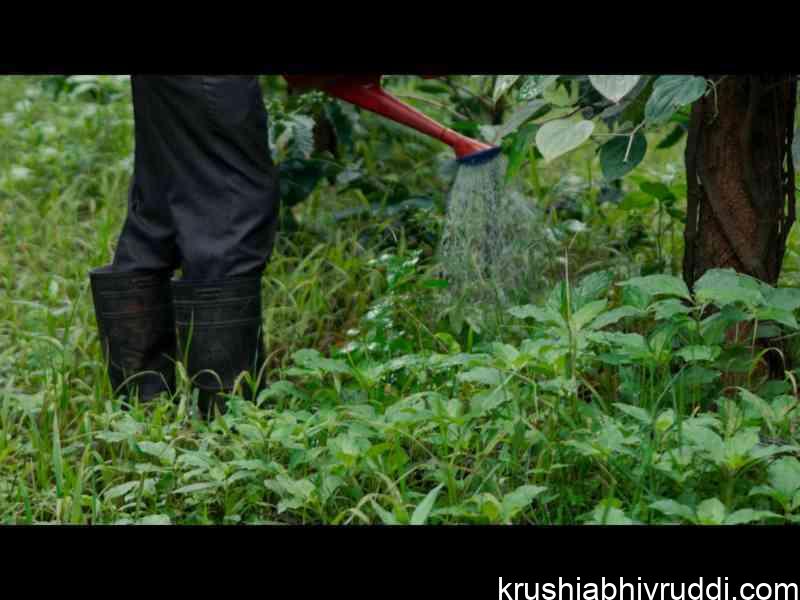
ICAR-CPCRI, for example, has specific recommendations for certain arecanut root and foot-rot situations involving soil drenching, showing that the method, concentration and volume are disease-specific.
Therefore, farmers should not copy another farmer’s drenching practice without knowing the disease, active ingredient, concentration and recommended application method.
What Happens When We Use Too Much?
The first problem may be unnecessary expense. But the consequences can go further.
1. Beneficial Microorganisms Can Be Disturbed
Our soil is not empty. It contains enormous numbers of microorganisms. Some fungi and bacteria are beneficial to plants.
Beneficial organisms participate in decomposition, nutrient cycling and interactions around plant roots. Biological control organisms such as Trichoderma and certain beneficial bacteria are also used to suppress plant pathogens.
A fungicide is designed to affect fungi or fungal pathogens. Therefore, depending on the product, concentration and exposure, non-target microorganisms may also be affected.
This is one reason why indiscriminate fungicide application can disturb the biological balance around the crop.
2. Disease Resistance Can Develop
This is one of the most important dangers of repeated and improper fungicide use.
A pathogen population contains many individuals. When a fungicide with a particular mode of action is repeatedly used, sensitive individuals are controlled while less-sensitive individuals may survive and reproduce.
Over time, the population can become less sensitive to that fungicide.
This is called fungicide resistance.
FRAC recommends using effective labelled rates, avoiding repeated reliance on the same mode of action, and using appropriate alternation or mixtures where recommended. Repeated reduced-rate applications can actually increase selection pressure and accelerate resistance development.
Therefore, both excessive doses and repeated improper applications can be problematic.
3. The Farmer May Become Dependent on Chemicals
If every disease symptom is immediately followed by a fungicide spray, other important disease-management practices may be neglected.
But drainage, sanitation, removal of severely diseased plant parts, proper spacing, canopy management, resistant varieties, balanced nutrition and irrigation management can all influence disease development.
ICAR-CPCRI’s arecanut recommendations, for example, emphasize drainage, sanitation and other cultural practices along with fungicide use.
What About Biological Control Agents?
Nature itself has its own disease-control system.
Beneficial microorganisms such as Trichoderma, Bacillus and certain Pseudomonas species can compete with or suppress plant pathogens through different mechanisms.
For example, Trichoderma species can colonize the root zone and compete with harmful fungi. Some biological agents can produce substances that inhibit pathogens, while others stimulate plant defence mechanisms.
ICAR-CPCRI has also investigated Trichoderma harzianum formulations for management of diseases such as Ganoderma in arecanut.
These biological agents should not be considered a magical replacement for every fungicide. They work best as part of an integrated disease-management system and must themselves be used according to product recommendations.
Fungicide Is a Tool—Not the Entire Disease-Management System:
The most important concept farmers should remember is this:
Fungicides are tools for disease management, not tools for making the crop completely free from every pathogen.
A pathogen may survive in soil, plant debris, roots, water, neighbouring plants or other parts of the farm. Even when a fungicide greatly reduces disease, it does not necessarily mean that every pathogen has been eradicated.
Therefore, agricultural experts generally speak about disease control or disease management, rather than promising complete eradication.
FRAC also emphasizes that fungicides are only one component of disease management and should be combined with agronomic practices, sanitation, resistant varieties and biological approaches where appropriate.
The Farmer’s Rule: Use Less—But Use Correctly:
The answer is not to completely stop using fungicides.
The answer is to use them scientifically.
Before application, ask:
- What is the actual disease?
- Is the pathogen confirmed or only suspected?
- Which active ingredient is recommended?
- What is the label dose?
- What is the correct quantity of water?
- Should it be sprayed or drenched?
- What is the correct timing?
- How many applications are permitted?
- What is the fungicide’s mode of action?
- Can cultural or biological methods reduce the need for another application?
Remember,
More fungicide does not necessarily mean more protection.
The right fungicide, at the right dose, by the right method, at the right time, combined with good farm management, gives better long-term disease management.
Our aim should not be to destroy every fungus in the farm.
Our aim should be to suppress harmful pathogens while protecting the living biological system that keeps our soil and crops healthy.


