


Gutkha Ban: A Public-Health Decision, an Addiction Challenge and an Arecanut Farmer’s Concern
Karnataka has recently taken a significant public-health decision by prohibiting the manufacture, storage, transportation, distribution and sale of Gutkha, tobacco-containing pan masala and other products containing tobacco or nicotine for one year. The notification was issued under the Food Safety and Standards Act and the relevant food-safety regulations.
The decision has already generated a different kind of discussion in Karnataka. Some legislators have raised concerns about its possible impact on arecanut growers. The issue has also drawn the attention of the Chief Minister and the Health Department. While the government’s stated position is based on public health, another question is equally important:
Will a gutkha ban actually stop people from consuming gutkha and other addictive chewing products?
This is not an argument against the government’s concern for public health. Nor is it an argument in favour of gutkha consumption. Gutkha is harmful, and tobacco use is a major cause of preventable disease. WHO notes that smokeless tobacco is a major form of tobacco use in India and that tobacco is associated with cancer and several other serious diseases.
But when a government takes a major decision, it is also reasonable to examine how effectively that decision can achieve its intended objective.
What exactly is gutkha?
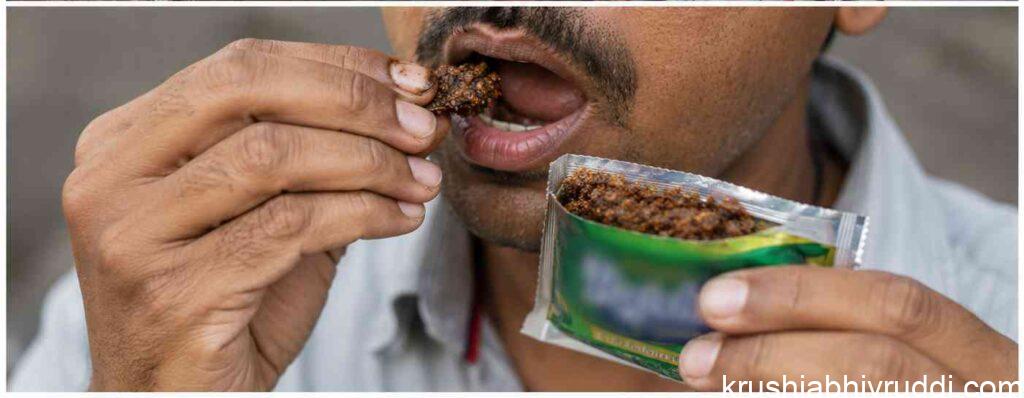
Gutkha is a commercially prepared smokeless chewing product generally containing arecanut, tobacco, slaked lime, catechu, flavourings and sweeteners. The exact formulation can vary between products.
There is also an important distinction in the present discussion.
In some markets, the arecanut-based pan masala and tobacco are supplied in separate sachets, allowing the consumer to mix them. Therefore, simply removing tobacco from one packet does not necessarily mean that the consumer has stopped using tobacco.
This is one of the practical questions surrounding enforcement.
If a consumer can purchase an arecanut-based product from one place and tobacco from another place and combine them before chewing, then the question becomes:
Has the habit actually disappeared, or has only the method of obtaining the ingredients changed?
The Karnataka notification appears to have attempted to address this type of arrangement by covering products that are separately packaged but marketed or distributed in a manner that facilitates mixing by the consumer.
The health concern cannot be ignored:
The health argument behind the ban is very serious.
Gutkha and other smokeless tobacco products are associated with oral cancer and other diseases. More importantly, the problem is not limited to tobacco alone.
The International Agency for Research on Cancer has classified areca nut itself as carcinogenic to humans. IARC has also concluded that betel quid without tobacco can cause oral cancer.
Therefore, the statement that removing tobacco alone would automatically make an arecanut chewing product safe would not be scientifically correct.
This distinction becomes particularly important in Karnataka because the state has a large population of arecanut growers.
But there is another side — the farmer
Here the discussion becomes complicated.
Arecanut is not merely another agricultural commodity in Karnataka. It is a major horticultural crop supporting thousands of farming families and an extensive network of labourers, traders, processors, transporters and market intermediaries. It is also important to recognise that the gutkha sector, in which arecanut is an important raw material, contributes crores of rupees to government revenues through various taxes. Therefore, any policy decision concerning gutkha must consider not only its public-health consequences, but also its wider economic and fiscal implications.
Gutkha is certainly not the only use of arecanut. However, commercial chewing products constitute an important part of the demand chain for processed arecanut.
Therefore, when restrictions on tobacco-containing chewing products are suddenly strengthened, the immediate question among farmers is understandable:
If demand from one major segment falls, who will absorb the arecanut produced by farmers?
Reports following Karnataka’s announcement have already carried concerns from arecanut-growing regions about falling market prices and the possible economic impact on growers.
The concern is therefore not necessarily about supporting gutkha.
It is about protecting farmers from the unintended economic consequences of a public-health policy.
The price movement is already attracting attention:
After the announcement, reports of weakness in arecanut prices began emerging from important markets. Different grades do not necessarily react in exactly the same way, but growers have reported concerns regarding red supari, white supari and lower-quality sun-dried arecanut.
This raises an important policy question.
If the government wants to reduce gutkha consumption for health reasons, should it simultaneously prepare an economic transition plan for farmers who depend on arecanut?
The two issues may appear unrelated, but economically they are connected.
The government may be able to prohibit a product through regulation. But a farmer cannot immediately change a mature arecanut plantation into another crop.
Arecanut is a long-duration crop. Farmers have invested years of labour, irrigation, land and money in establishing their gardens.
The bigger question: will consumers really stop?
This may be the most difficult part of the entire issue.
Banning the sale of an addictive product and eliminating addiction are two different things.
Experience from places where tobacco-containing gutkha has already been prohibited raises the possibility of illegal or black-market supply. Historical discussions around gutkha bans in India have also pointed to the challenge of enforcement and continued availability through unofficial channels.
An addicted consumer may not simply decide to stop because the product is unavailable in a legal shop.
He may search for another source.
He may pay a higher price.
He may shift to another tobacco product.
Or he may start preparing a similar chewing mixture using separately available ingredients.
That is why the real test of a ban is not simply:
“Can the government stop shops from selling gutkha?”
The more important question is:
“Can the government reduce the number of people who actually consume it?”
These are two different measurements.
Could consumption shift to another habit?
This is another area worth examining.
If gutkha becomes difficult to obtain, some consumers may move towards other forms of smokeless tobacco, traditional tobacco-containing paan, zarda, khaini or other products.
WHO identifies several forms of smokeless tobacco commonly used in India, including gutkha, khaini, chewing tobacco and tobacco-containing betel quid.
Therefore, if the objective is health protection, merely changing the name or packaging of the product may not achieve the desired result.
The consumer’s behaviour is ultimately more important than the brand name.
What about cigarettes and beedis?
This question is also being raised in the public discussion.
If tobacco is the central health concern, why should cigarettes, beedis and other tobacco products not receive equally strong attention?
Of course, different tobacco products have different patterns of use, risks and regulatory frameworks. But from an ordinary citizen’s perspective, the broader question remains:
Should tobacco-control policy concentrate on one form of consumption, or should it address addiction across all forms?
WHO identifies both smoking and smokeless tobacco as important tobacco-use categories in India.
This is therefore not simply a gutkha question.
It is a tobacco-control question.
Could regulation be combined with prohibition?
Another possibility deserves consideration.
Instead of relying only on prohibition, could the government simultaneously introduce stronger measures to reduce the addictive and harmful characteristics of such products?
For example, governments could consider stricter regulation of ingredients, packaging, marketing, taxation, accessibility and enforcement, together with scientifically evaluated cessation programmes.
The objective would not be to make gutkha “safe.” There is no basis for treating tobacco or arecanut products as harmless. IARC specifically recommends avoiding or stopping tobacco and arecanut use as part of oral-cancer prevention.
But from a policy perspective, there is room to ask whether prevention, cessation, regulation and enforcement should operate together rather than depending on prohibition alone.
Can science provide an alternative?
This is another interesting possibility.
Instead of allowing consumers to move from one harmful product to another, could government-supported research develop acceptable, genuinely safer alternatives that do not contain tobacco or nicotine and do not rely on carcinogenic arecanut?
There are already examples of Indian scientific institutions working on alternatives.
For example, CSIR-National Botanical Research Institute has developed Herbichew, described on the Government of India’s India Science, Technology and Innovation portal as a tobacco- and chemical-free herbal mixture designed as a mouth freshener and herbal tobacco alternative.
Such developments raise another question:
Could more public funding and research be directed towards scientifically validated alternatives and tobacco-cessation technologies?
If successful alternatives are developed, the government could potentially address the consumer’s behavioural dependence while reducing exposure to harmful substances.
What about the arecanut farmer?
There is another policy issue that cannot be separated from this debate.
For years, arecanut cultivation has expanded in several parts of Karnataka. Farmers have invested heavily in plantations, irrigation, fertilisers, labour and infrastructure.
If the government considers gutkha and tobacco-related consumption a major health problem, then perhaps the long-term agricultural question also needs attention:
Should the expansion of arecanut cultivation continue without a parallel strategy for diversification and alternative markets?
A sudden reduction in demand could create difficulties.
But allowing demand to grow indefinitely because farmers depend on the crop could also create a different problem if that demand is increasingly connected to products that create serious health concerns.
This is where agricultural policy and health policy meet.
“The root should not remain while only the branch is cut”
The present situation brings us to a simple comparison.
If the government wants to protect people from the harmful effects of gutkha, banning the product may address its availability.
But addiction, consumer behaviour, illegal supply, alternative tobacco products and agricultural dependence are deeper issues.
Therefore, the question is not whether gutkha is harmful.
The scientific evidence on tobacco and arecanut-related health risks is already substantial.
The question is whether a one-year prohibition, by itself, can produce the intended public-health outcome.
At the same time, the economic consequences for arecanut growers cannot simply be ignored.
Two problems, one policy decision
Karnataka is therefore facing two different but connected questions.
First: How can the government reduce tobacco and gutkha addiction and protect people from cancer and other tobacco-related diseases?
Second: If restrictions reduce demand for arecanut-based chewing products, how will the government protect farmers from a sudden economic shock?
Neither question can simply be pushed aside.
A public-health measure may be necessary from the government’s perspective. But an agricultural transition may also be necessary from the farmer’s perspective.
The real challenge may therefore be finding a policy in which public health is protected, addiction is reduced, and farmers are not left to bear the entire economic burden of the transition.
For now, these remain questions for society, policymakers, health experts and farmers to examine.
Will the ban reduce consumption?
Will it eliminate addiction?
Will black-market sales increase?
Will consumers shift to other tobacco products?
How much will arecanut demand actually fall?
And how will the government manage the future of arecanut farmers if that demand declines?
These are questions that only time, enforcement data, consumption statistics and agricultural market trends may answer.


