


There is a common statement made by some environmentalists and anti-chemical activists: “Honey bee populations are decreasing because farmers are spraying pesticides on their crops.”
There is some truth in this statement. Certain pesticides can certainly harm honey bees and other pollinators, particularly when they are misused or when bees are exposed to them during flowering.
However, saying that pesticides alone are the reason for the decline of honey bees is not a complete explanation.
Honey bees and other pollinators are facing several pressures at the same time. Among them are loss of natural shelter, shortage of diverse food sources, destruction of natural habitats, diseases, climate change, changes in agricultural practices, predators and inappropriate pesticide exposure.
One important problem, however, is often overlooked: Where are the natural homes and food sources for bees today?
Where Did the Natural Homes of Honey Bees Go? :
The Indian honey bee, Apis cerana, is a cavity-nesting bee. It naturally lives in protected spaces such as cavities inside trees and other suitable natural shelters. In parts of Karnataka, traditional observations and field studies have also recorded these bees using cavities and, in some situations, earthen structures and termite mounds.
If we look back 20 or 30 years, our surroundings were very different.
There were more:
- large old trees,
- trees with natural cavities,
- dead and hollow trees,
- trees along farm boundaries,
- forest trees,
- termite mounds,
- natural soil cavities,
- bushes and wild vegetation.
These were not useless structures. They were homes for thousands of small creatures. Honey bees and other insects could find safe places to establish their colonies. Today, many of these natural shelters are disappearing.
As forests are cleared, farms expand, old trees are removed, land is levelled and soil is disturbed for cultivation and development, many natural cavities disappear. A farmer may see an old hollow tree as a useless or unwanted tree.
But for a honey bee, that hollow may be a home.
A Tree Cavity Is Not Just a Hole:
An old tree with a cavity may look insignificant to us. But inside it there may be:
- honey bees,
- native bees,
- other insects,
- birds,
- small animals,
- microorganisms.
Therefore, when old trees disappear, it is not only the tree that disappears. An entire small ecosystem associated with that tree may disappear. This is one reason why protecting some old trees in agricultural landscapes can be important for biodiversity.
What About Termite Mounds and Soil Cavities?:
In earlier agricultural landscapes, termite mounds and natural soil cavities were common. Some bees and other insects use such structures as shelter. But when land is continuously dug, levelled and modified, these natural structures are destroyed. A cavity that once provided protection may no longer exist.
Even when bees establish colonies in soil cavities or other temporary locations, they may face additional risks from:
heavy rain → flooding → waterlogging → destruction of the colony. So the question should not be only:
“Are there pesticides?” We should also ask: “Are there enough safe places for bees to live?”
Honey Bees Are Not the Only Pollinators:
Another common misunderstanding is: “Honey bees are the only pollinators.” That is not correct. Honey bees are extremely important pollinators, but they are only one part of a much larger pollinator community.
Wild bees, stingless bees, flies, butterflies, moths, beetles, wasps and, depending on the plant, even some birds and bats can contribute to pollination. Therefore, when we lose natural habitats, we are not losing only honey bees.
We may be losing an entire community of pollinators. This is important because different pollinators visit different flowers and have different behaviours. Protecting pollination therefore means protecting the whole ecosystem, not just one species.
Where Is Their Food?
A bee needs two basic things: A safe home and sufficient food. For honey bees, flowers are the main source of food. Nectar provides energy, while pollen provides protein and other nutrients needed by the colony. In the past, agricultural landscapes contained many different trees, shrubs and wild plants. They did not all flower at the same time. When one species finished flowering, another species would begin. This created a more continuous food supply.
Many traditional and wild trees such as different species of jamun, wild jamun, soapnut, tamarind, pongamia and numerous forest trees and shrubs can provide flowers that bees use as food. But many of these plants are becoming less common in agricultural landscapes. When these plants disappear, the diversity of food available to bees also decreases.
A Large Crop Does Not Necessarily Mean Plenty of Food:
Today, we may see large areas under a single crop. The field may look green and productive.But from the point of view of a pollinator, the situation can be very different. A crop may flower heavily for only a few weeks or months.
After flowering is over, the same field may provide very little food for bees. This is why a landscape containing different flowering plants at different times of the year can be much more valuable to pollinators than a landscape dominated by a single crop.
The question is not simply: “How many flowers are there today?” It is: “Can bees find food throughout the year?”
What About Pesticides?
Now we come to the most discussed issue — pesticides. It would be wrong to say that pesticides do not affect bees. Some pesticides can kill bees directly. Others can affect their behaviour, feeding, navigation, reproduction or colony health, depending on the chemical, dose and exposure.
Therefore, farmers must use pesticides carefully and strictly according to the label and recommended practices. Particular care is needed during flowering when bees are actively visiting flowers.
Unnecessary spraying should be avoided, and Integrated Pest Management (IPM) practices should be encouraged wherever practical. However, there is another important point. The colour label on a pesticide container should not be interpreted as a bee-safety label. In India, the red, yellow, blue and green colour bands primarily indicate categories related to acute toxicity to humans.
They do not simply mean:
red = dangerous to bees or
yellow/green = safe for bees.
Therefore, farmers should not judge pollinator safety merely from the colour band. The active ingredient, dose, crop, timing, application method and specific precautions are much more important.
Pesticides Are One Pressure — Not the Entire Story:
Scientific research increasingly supports a more complex picture. Habitat loss and pesticide exposure can independently affect wild bees and other pollinators. A recent large-scale study covering hundreds of agricultural fields found that both pesticide exposure and loss of natural habitat were associated with reductions in wild-bee abundance and diversity.
This is an important message. We should not ask:
“Is it pesticides or habitat loss?” We should ask:
“How are all these pressures acting together?” That is a much more useful question.
Another Often-Ignored Problem — How We Extract Honey.
There is another human activity that deserves attention: he way honey is collected from natural colonies. Traditional honey collection has existed for generations. But when honey is extracted using unscientific or destructive methods, the entire colony can be put at risk.
For example, excessive smoke may be used to drive bees away. The comb may be roughly handled or destroyed. Brood may be damaged, and the colony may be disturbed unnecessarily. Smoke itself is not necessarily harmful when used properly. Beekeepers use controlled smoke as a management tool.
The problem is excessive or improper use of smoke and destructive extraction methods.
The Queen Bee Must Be Protected:
Among all the bees in a colony, the queen has a special role. The queen is the reproductive centre of the colony. If she is seriously injured or lost, the colony can become severely weakened, particularly if it cannot successfully rear a replacement queen.
Therefore, a person collecting honey from a natural colony should take great care not to damage the queen or the brood area. If the colony is destroyed simply to obtain honey, the collector may get honey once. But if the colony survives, it can continue producing honey in the future.
So the principle should be: Take the honey — but save the bee colony.
Precautions for Traditional Honey Collectors:
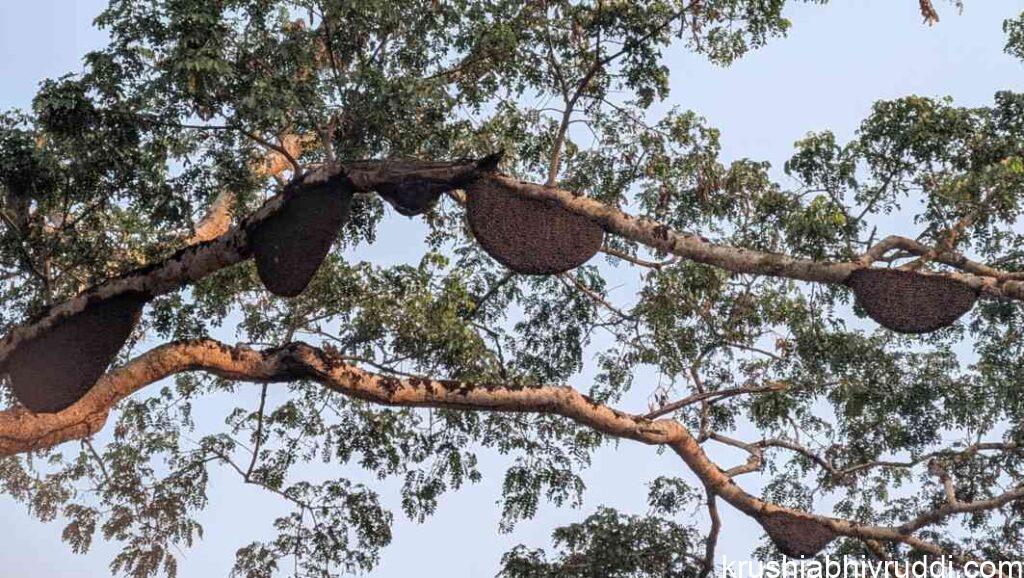
People who collect honey from natural colonies should be encouraged to adopt safer and more scientific methods. They should:
- avoid excessive smoke,
- avoid physically damaging the colony,
- protect the queen,
- avoid unnecessary damage to brood,
- avoid destroying the entire comb,
- leave enough resources for the colony to survive,
- allow the colony to rebuild after extraction,
- and avoid repeated disturbance of the same colony.
Honey collection should become a sustainable activity rather than a one-time destruction of a colony. This is beneficial not only to the bees but also to the honey collector. A living colony can produce honey again.
An Interesting Observation: Why Do Bees Occupy Boxes So Easily?
There is an interesting observation from modern beekeeping. When suitable bee boxes are placed in an appropriate location, honey bee colonies may occupy them without much difficulty. This tells us something important. The bees have not necessarily disappeared completely. In some places, suitable colonies are still available.
The problem may partly be that natural nesting places have become scarce or unsafe. A properly designed hive provides an artificial cavity that replaces one function of the natural tree cavity.
But putting a box in a farm is only one part of the solution. The surrounding environment must also provide enough food. A box can provide a house. It cannot create flowers.
We Must Protect the Entire Pollinator Habitat:
If we really want to protect honey bees, simply keeping a few bee boxes is not enough. We need to think about the entire farm environment. A good pollinator-friendly farm can contain:
old trees + flowering plants + natural vegetation + safe nesting spaces + water + responsible pesticide use.
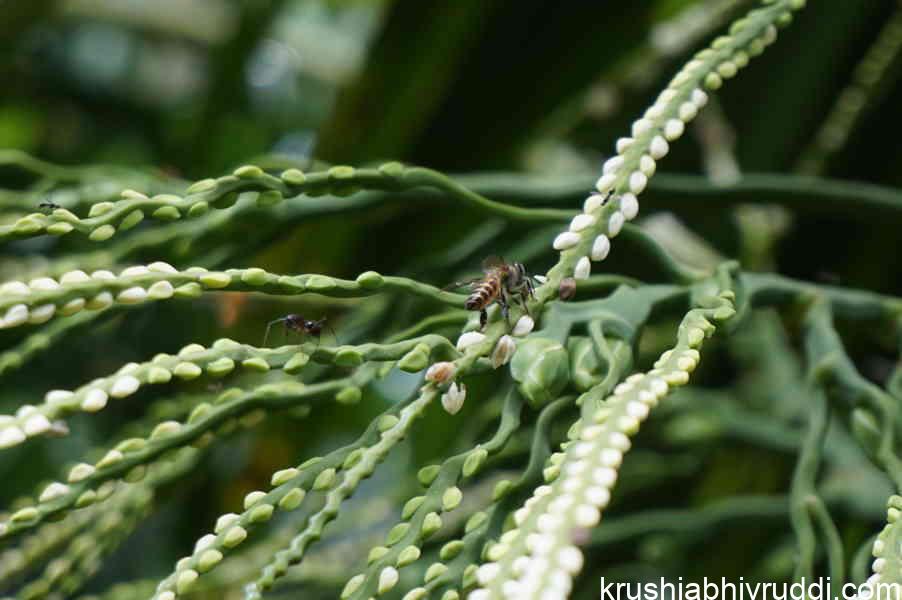
Farm boundaries, unused corners, drainage edges and suitable spaces can sometimes be used to maintain flowering plants without interfering with the main crop. Even small areas can provide valuable habitat when many farms adopt the same approach.
What Can Farmers Do?
Farmers do not have to stop agriculture to protect bees. Simple practices can make a difference.
1. Protect useful old trees
Not every old or hollow tree needs to be removed. Where it is safe, retaining old trees can preserve nesting sites for many organisms.
2. Maintain flowering plants
Keep suitable flowering plants in field boundaries and other non-crop areas.
3. Grow different flowering species
Plants that flower during different seasons can provide a more continuous food supply.
4. Avoid unnecessary pesticide applications
Use pesticides only when necessary and according to recommended practices.
5. Be careful during flowering
Avoid exposing actively visiting pollinators to pesticide sprays whenever possible and follow crop-specific safety recommendations.
6. Protect natural structures
Where practical, do not unnecessarily destroy every termite mound, natural cavity or patch of vegetation.
7. Encourage scientific honey collection
Traditional honey collectors should be trained in methods that protect the queen, brood and colony.
The Real Question We Should Ask:
When we see fewer honey bees in our surroundings, it is easy to blame one thing.
“Pesticides have killed them.” But nature is rarely that simple.
A bee needs:
- a place to live,
- flowers to feed on,
- a healthy colony,
- a suitable climate,
- protection from diseases and predators,
- and freedom from harmful levels of chemical exposure.
If any one of these becomes a serious problem, the colony can suffer. If several problems occur together, the impact can be much greater.
Conclusion
The statement that “honey bees are disappearing because of pesticides” is not completely wrong, but it is incomplete. Pesticides can certainly be one of the pressures on bees, and their responsible use is important. But at the same time, we must not ignore the silent changes happening around us.
- Where are the old trees?
- Where are the natural cavities?
- Where are the termite mounds and other natural shelters?
- Where are the wild flowering plants?
- Where are the trees that provided flowers at different times of the year?
- Are our agricultural landscapes still providing food and shelter for pollinators?
These questions deserve as much attention as pesticide use. Perhaps the biggest lesson is this:If we want bees in our farms, we must create a farm where bees can live.
- Give them a house.
- Give them flowers.
- Protect their colonies.
- Use pesticides responsibly.
- And when collecting honey, take the honey without destroying the family that produced it.
Because saving honey bees is not simply about saving honey. It is about protecting the pollination system on which our agriculture itself depends. Are Pesticides Really the Main Reason for the Decline of Honey Bees?”


